
Strategic Planning vs Strategic Thinking: What’s the Difference?
If you’ve ever sat in a meeting where someone said, “We need to be more strategic,” you may have wondered what they really meant. Usually, the answer comes down to strategic planning vs strategic thinking.
Do they mean we need a better plan? Or are they asking for better thinking?
This confusion happens often because strategic planning and strategic thinking sound similar. However, they serve very different purposes inside an organization. Understanding strategic planning vs strategic thinking matters because, although the two depend on each other, they are not interchangeable.
The Short Answer
Strategic thinking is how leaders decide which direction to take and why. It’s continuous, exploratory, and focused on insight. Strategic planning is how the organization turns that direction into goals, owners, measures, and timelines. It’s structured, documented, and time-bound.
In other words, strategic thinking differs from strategic planning in that thinking asks “What should we be doing, and why?” while planning asks “What are we going to do, and how?”
What Is Strategic Planning?
Strategic planning is the structured process of defining where your organization is going and how it will get there.
It typically includes:
- Mission and vision clarification
- Strategic goals and strategic objectives
- Initiatives and action plans
- KPIs and performance tracking
- Timelines and accountability
Strategic planning answers the question: “What are we going to do?”
Strategic planning is formal, documented, and measurable. As a result, it creates clarity across the organization. In many organizations, it produces a written strategic plan or roadmap that guides execution over one to five years.
What Is Strategic Thinking?
Strategic thinking is different. Rather than a document, it’s a mindset and a way of reasoning.
Strategic thinking involves:
- Seeing patterns and trends
- Anticipating risks and opportunities
- Connecting actions to long-term outcomes
- Challenging assumptions
- Considering multiple scenarios
It answers the question: “What should we be doing, and why?”
Strategic thinking is exploratory and creative, and it often happens before planning begins. You can have strategic thinking without a formal plan, but effective strategic planning depends on strategic thinking. For more on what makes a decision truly strategic, read What Does “Strategic” Mean in Business?
Strategic Planning vs Strategic Thinking: Side-by-Side Comparison
| Strategic Thinking | Strategic Planning | |
|---|---|---|
| What it is | A mindset | A structured process |
| Main question | What should we do, and why? | What will we do, and how? |
| Output | Insight and direction | A documented plan with goals, owners, and measures |
| Focus | Possibility and positioning | Execution and accountability |
| Style | Exploratory and future-oriented | Measurable and time-bound |
| Timing | Continuous | Often annual or quarterly |
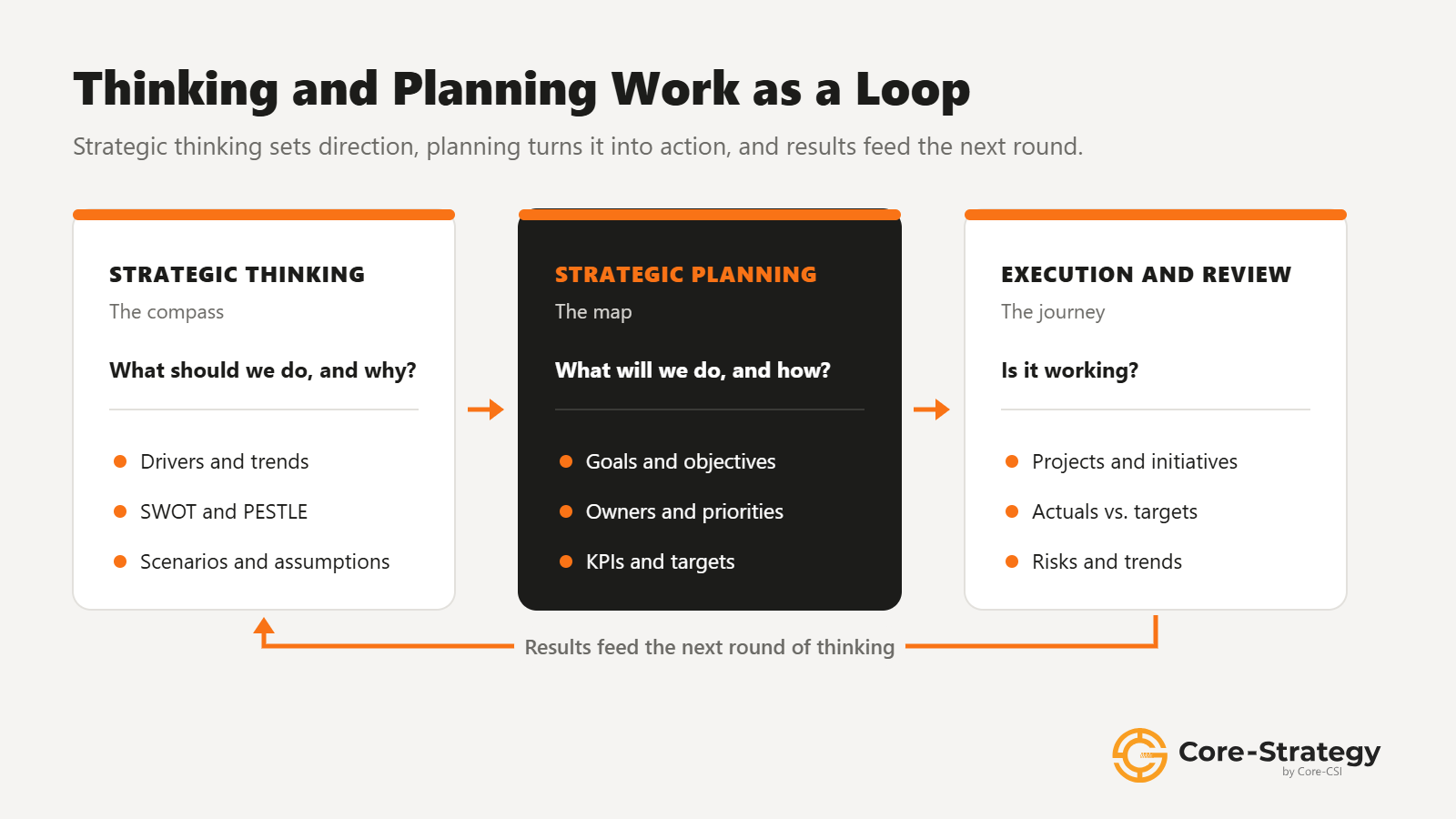
Think of it this way: strategic thinking is the compass, and strategic planning is the map. You need both to move forward with confidence.
Why Organizations Confuse the Two
Many teams skip the deeper thinking required before committing to action. As a result, they create activity without clarity.
As MIT Sloan Management Review has noted, formal planning tends to produce steps and actions, while genuinely strategic decisions often happen outside the formal process. Planning and strategic thinking are different, but they’re meant to work together.
When they don’t, organizations end up with busy teams but unclear direction, KPIs that don’t drive outcomes, and plans that look polished but fail to adapt.
When to Use Strategic Thinking
Strategic thinking becomes especially important during periods of uncertainty. For instance, when entering a new market or responding to disruption, leaders must reassess their assumptions. This is the phase where you pause before committing resources.
Before formal strategic planning begins, teams often use tools like SWOT analysis, PESTLE analysis, and scenario planning to test ideas and surface risk.
When to Use Strategic Planning
Once the direction is clear, strategic planning translates insight into action. This is where you:
- Define measurable goals and objectives
- Align teams
- Assign ownership
- Establish performance tracking
- Create accountability
Planning ensures strategic ideas don’t stay theoretical. If your team struggles to move from great ideas to real execution, the gap is usually in structured planning.
The Real Answer: You Need Both
The question isn’t strategic planning vs strategic thinking as a competition. Instead, it’s about sequence and connection.
First, strategic thinking generates insight. Then, strategic planning organizes execution. Finally, performance management sustains progress, and what you learn feeds back into the next round of thinking. Because conditions change, high-performing organizations cycle between thinking and planning continuously.
Common Mistakes to Avoid
1. Planning Without Thinking
Creating detailed action plans without examining long-term positioning. The plan looks complete, but nobody can explain why these goals were chosen over others.
2. Thinking Without Planning
Having visionary leadership discussions that never translate into measurable goals, owners, or deadlines.
3. Treating Strategy as Static
Writing the plan once and failing to revisit assumptions as conditions change.
All three mistakes share a root cause: the thinking and the planning live in different places, with nothing connecting them.
Where Thinking and Planning Break Apart, and How Core-Strategy Connects Them
Most organizations don’t lack strategic thinking or strategic planning. They lack a way to keep the two connected. The SWOT lives in one slide deck, the strategic plan in another document, the KPIs in a spreadsheet, and the projects in a project tool. Here are the four places the connection most often breaks, and how Core-Strategy fixes each one.
1. Insights Get Lost Before They Reach the Plan
The problem: Leadership teams spend a day on SWOT and PESTLE analysis, identify the forces that will shape the next few years, and then file the results away. When the strategic plan is written weeks later, the goals no longer trace back to the insights that were supposed to drive them. A year later, nobody remembers why the organization chose its priorities.
How Core-Strategy solves it: Core-Strategy’s environment scanning tools keep your strategic thinking in the same system as your plan. You capture the internal and external drivers that motivate change, run SWOT and PESTLE analysis, and map the business capabilities your organization needs. Because these live alongside your goals and objectives, you can always see which insight a goal responds to.
2. Ideas Never Get Owners
The problem: This is thinking without planning. A strategy retreat produces strong ideas, but nobody turns them into goals with owners, deadlines, and budgets. Without that step, the ideas quietly fade as day-to-day work takes over.
How Core-Strategy solves it: With Core-Strategy’s strategy formulation tools, you build the strategic plan itself: goals, priorities, assignments, and approvals. Every objective and measure gets a named owner, and the initiatives that will move it are linked directly to it. Ideas become commitments with someone accountable for each one.
3. Plans Turn into Activity Without Direction
The problem: This is planning without thinking. The plan fills up with projects and tasks, but the link back to strategic intent disappears. Teams stay busy, yet leaders can’t tell which work is actually moving the strategy forward.
How Core-Strategy solves it: The strategy map lays out your objectives across the four Balanced Scorecard perspectives, with cause-and-effect links showing how each one supports the next. You can filter by strategic theme to see which objectives serve which direction, and drill into any objective to see the KPIs that measure it and the projects driving it. Work that doesn’t connect to an objective stands out.
4. Strategy Gets Treated as Static
The problem: The plan is approved, and then it isn’t revisited until next year’s planning cycle. Meanwhile, markets shift, assumptions break, and the organization keeps executing a plan built for conditions that no longer exist.
How Core-Strategy solves it: Core-Strategy tracks every KPI against its target period by period, with charts and trend lines that show which measures are slipping before review meetings. AI-Enhanced summaries flag risks on any KPI in one click, and the strategy roadmap keeps the plan visible over time. When results start drifting, that’s the signal to return to strategic thinking, revisit your drivers and assumptions, and adjust the plan in the same system.
The result is a continuous loop instead of a once-a-year event: thinking informs the plan, the plan drives execution, and execution data feeds the next round of thinking.
Final Takeaway
If you remember one thing about strategic planning vs strategic thinking, let it be this: strategic thinking determines the right direction, and strategic planning determines the right execution.
When they’re connected, they create momentum. When they’re separated, they create frustration.
Strategy is not the plan — it’s the system. Request a demo at Core-Strategy to see how your strategic thinking and strategic planning can live in one connected system.
Frequently Asked Questions
What is the difference between strategic planning and strategic thinking?
Strategic thinking is a continuous, exploratory way of deciding which direction to take and why. Strategic planning is a structured process that turns that direction into documented goals, owners, measures, and timelines.
Which comes first, strategic thinking or strategic planning?
Strategic thinking usually comes first, because it produces the insight that a plan is built on. In practice, the two run in a cycle: results from executing the plan feed the next round of strategic thinking.
Can you do strategic planning without strategic thinking?
You can, but the result is usually a plan full of activity that isn’t tied to a clear direction. Without strategic thinking, planning tends to repeat last year’s priorities instead of responding to what has changed.
How does Core-Strategy support both strategic thinking and strategic planning?
Core-Strategy keeps both in one system. Environment scanning tools like SWOT, PESTLE, drivers, and capability mapping support strategic thinking, while the strategic plan, strategy map, KPIs, and owners turn that thinking into measurable execution.