
Strategic Objectives: How to Define Them (With Examples)
Knowing how to define strategic objectives is where good strategy starts, and it’s where many plans go wrong. Strategic planning often fails for one simple reason: organizations mix up goals, objectives, measures, and initiatives.
When those pieces blur together, strategy becomes a list of good intentions instead of a roadmap for action.
If your team has ever said “We want to grow,” “We want to improve,” or “We want to innovate,” you’re not alone. These statements point in a direction, but they aren’t objectives yet.
In this guide, we’ll walk through how to define an objective in strategic planning, and why the strongest strategies keep the objective, the measure, and the target as separate pieces. We’ll also look at where objectives most often break down after the planning workshop, and how Core-Strategy keeps every objective connected to the measures, owners, and projects that move it.
Why Objectives Matter in Strategy Planning
Strategy planning connects vision to execution. Objectives are the bridge between the two.
Without clear objectives:
- Teams don’t know what success looks like
- Progress can’t be measured
- Priorities compete instead of align
- Strategy stalls after the planning workshop
Strong objectives create clarity and momentum. They turn direction into decisions.
What Are Strategic Objectives?
An objective is a short, action-oriented statement of what your organization must do well for the strategy to succeed.
Objectives answer the question: “What must we get right to reach our goals?”
A good objective usually starts with a verb and names one thing: Increase Customer Retention, Improve Project Delivery, Strengthen Leadership Skills.
Objectives are not:
- Tasks
- Projects
- Initiatives
- Wishful thinking
Notice what an objective doesn’t include: the numbers. Those belong to the objective’s measures and targets. Keeping them separate is what lets you track progress without rewriting your strategy every time a target changes.
Goals vs. Objectives vs. Measures vs. Initiatives
This confusion is one of the biggest barriers in strategy planning. Most teams squeeze the objective, the metric, and the number into one sentence. Here’s how the pieces fit together:
| Term | What It Means | Example |
|---|---|---|
| Goal | Broad direction or aspiration | Improve customer experience |
| Objective | What we must do well to get there | Increase Customer Retention |
| Measure (KPI) | How we’ll know it’s working | Customer retention rate |
| Target | The level we’re aiming for, and by when | 85% by Q4 (from 72%) |
| Initiative | The work that closes the gap | Launch a customer loyalty program |
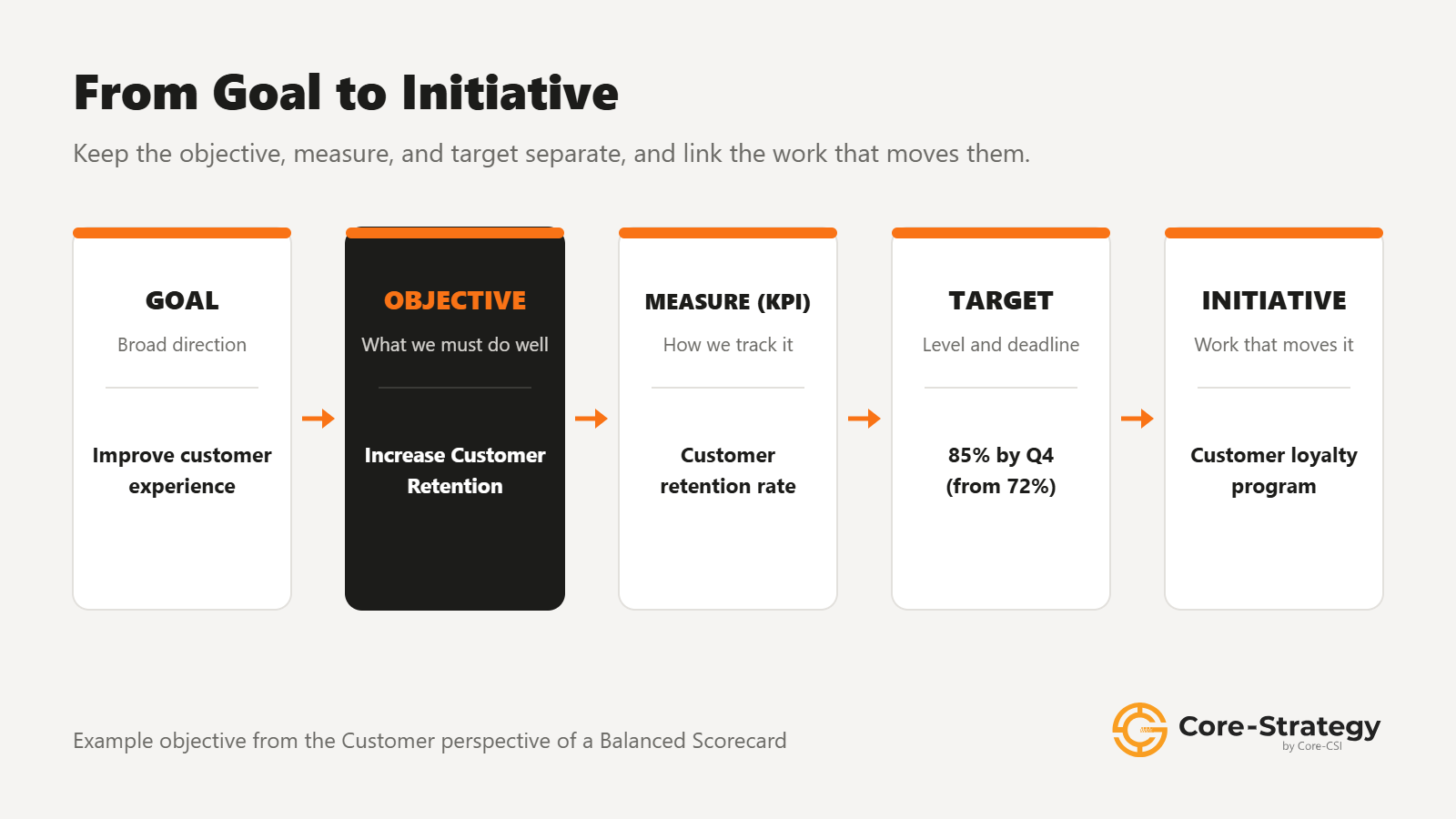
If you skip the objective, your strategy becomes a list of initiatives with no clear purpose. If you skip the measure and target, you can’t tell whether the objective is being met.
The 5 Qualities of a Strong Strategic Objective
When you define strategic objectives, check each one against five key criteria.
1. Outcome-Focused
Objectives describe results, not activities.
Weak: Implement a new CRM
Strong: Improve Sales Conversion
The CRM is an initiative. Better sales conversion is the outcome it’s meant to produce.
2. Measurable
If you can’t measure it, you can’t manage it. Every objective needs at least one measure (KPI) that shows whether it’s being achieved, such as:
- Percentages
- Revenue targets
- Ratios
- Growth metrics
The objective names what matters. The measure shows whether you’re getting there.
3. Time-Bound
Every objective’s target needs a deadline. Without a timeframe, urgency disappears and progress stalls.
Examples:
- Within 12 months
- By Q4
- Over the next 18 months
4. Aligned to Strategy
Every objective must clearly support your strategic priorities. If an objective doesn’t move the strategy forward, it creates distraction.
A strategy map makes alignment visible by showing how each objective supports the ones above it.
5. Ambitious but Realistic
Objectives and their targets should stretch the organization without breaking it.
Too easy → no change
Too unrealistic → no belief
The best targets sit in the middle: challenging but achievable.
Turning an Objective into a Measurable Target
Once the objective is clear, set a target for each of its measures using this structure:
Increase / Decrease / Achieve + Metric + From X to Y + By When
Examples:
- Grow Recurring Revenue → Increase annual recurring revenue from $5M to $7M within 12 months
- Retain Top Talent → Reduce employee turnover from 22% to 12% by Q4
- Improve Project Delivery → Achieve 95% on-time project delivery within 9 months
This formula removes vague language from your targets, while the objective stays short and easy to remember. Many organizations also use the SMART goals framework to check that targets are specific, measurable, and time-bound.
Common Mistakes When Defining Objectives
Even experienced teams slip into these pitfalls when they set strategic objectives:
Objectives With No Measure Attached
“Improve Customer Satisfaction” is a fine objective. It becomes a problem when nobody decides how it will be measured. Attach at least one KPI and a target to every objective.
Packing Everything into One Sentence
An objective like “Launch a loyalty program to increase retention from 72% to 85% by Q4” mixes the initiative, the measure, and the target. When the target changes or the program stalls, the whole objective has to be rewritten. Keep each piece separate.
Too Many Objectives
More objectives do not equal better strategy. Most organizations do best with roughly 10–15 objectives across the whole strategy, and only a few top priorities at any one time.
Jumping Straight to Initiatives
Teams often brainstorm projects before defining objectives. This leads to activity without alignment. Always define the objective first, then choose the initiatives that support it.
Every one of these mistakes comes from the same root cause: objectives, measures, targets, and initiatives living in different places, with nothing connecting them. Later in this guide, we’ll show how Core-Strategy solves each one by keeping all of those pieces in one linked system.
Many of these problems start earlier in the process, during environmental analysis. Learn more in our guides to PESTLE analysis and strategic planning and the common mistakes companies make with PESTLE analysis.
Strategic Objectives Examples for Each Balanced Scorecard Perspective
The Balanced Scorecard organizes strategic objectives into four perspectives. Here are three examples for each, with a measure and a target, so you can see how the pieces fit together.
Financial Strategic Objectives
- Increase Profitability: gross margin, from 42% to 50% within 18 months
- Grow Recurring Revenue: annual recurring revenue, from $5M to $7M within 12 months
- Reduce Operating Costs: operating cost as a percentage of revenue, from 38% to 32% by year end
Customer Strategic Objectives
- Improve Customer Loyalty: Net Promoter Score, from 38 to 55 by year end
- Increase Customer Retention: customer retention rate, from 72% to 85% by Q4
- Expand Market Presence: number of new customers in target segments, from 40 to 70 per year
Internal Process Strategic Objectives
- Speed Up Project Delivery: average project delivery time, from 14 weeks to 10 weeks in 12 months
- Improve Product Quality: defects per release, from 25 to 10 within two quarters
- Streamline Service Delivery: average case resolution time, from 5 days to 2 days by Q3
Learning & Growth Strategic Objectives
- Build an Engaged Workforce: employee engagement score, from 70% to 82% by the next annual survey
- Strengthen Leadership Skills: percentage of managers completing leadership training, from 40% to 90% in 12 months
- Improve Data and Technology: percentage of KPIs reported from live data, from 30% to 80% by year end
Each objective is short and clear, and its measure and target make progress easy to track. That’s the pattern to follow whenever you define strategic objectives.
In Core-Strategy, each of these objectives sits on the strategy map in its perspective, with its KPIs, targets, owner, and the projects that move it linked underneath. Filter by strategic theme, and you can see at a glance which objectives are on track and which need attention.
How Objectives Drive Execution
Once you define an objective, the next steps become clear:
- Choose KPIs to track progress
- Set targets for each KPI
- Prioritize initiatives that support the objective
- Assign ownership
- Monitor and adjust regularly
This is how strategy moves from planning to execution. The hard part is keeping those steps connected over months of real work, which is where most organizations struggle.
Where Objectives Break Down, and How Core-Strategy Fixes It
Defining strong objectives is the first half of the job. The second half is keeping them alive after the planning workshop. That’s where most organizations struggle, and it’s rarely because the objectives were badly written. It’s because the objectives, measures, owners, and projects end up scattered across slide decks, spreadsheets, and project tools, and nothing holds them together.
Here are the five places objectives most often break down, and how Core-Strategy addresses each one.
1. Objectives Lose Their Measures
The problem: An objective gets approved in the strategic plan, and its KPIs get tracked somewhere else, usually a spreadsheet that one person updates when they remember to. By the time the quarterly review comes around, nobody is sure whether the numbers are current, and the conversation turns to arguing about the data instead of acting on it. Over time, the objective and its measures drift apart until the objective is just a sentence in a document.
How Core-Strategy solves it: In Core-Strategy, every objective carries its own KPIs, each with a target, an actual, and a trend. Owners log monthly or quarterly actuals against targets, and the variance is calculated as they go. Each objective shows a live score on the Balanced Scorecard, so leaders see progress in real time instead of chasing spreadsheet updates.
2. Nobody Can See How Objectives Connect
The problem: Most organizations end up with a long list of objectives and no clear picture of how they relate. Leaders can’t tell which investments in people and processes are supposed to improve customer results, or which customer results drive financial performance. Without that picture, every objective looks equally important, the list keeps growing, and priorities compete instead of align.
How Core-Strategy solves it: The interactive strategy map lays out your objectives across the four perspectives, with linked arrows showing cause and effect from Learning & Growth up to Financial results. You can filter by strategic theme, such as Business Growth or Operational Excellence, to isolate the objectives that serve it. When a theme has more objectives than it can support, or an objective connects to nothing, the map makes it obvious.
3. Objectives, Measures, and Targets Get Tangled Together
The problem: When the objective, the measure, and the target are written as one long sentence, every change forces a rewrite. If a target moves from 85% to 80% mid-year, the “objective” changes too, and the history of what you were trying to achieve gets lost. Teams also start treating the number as the strategy, which leads to hitting the target while missing the point.
How Core-Strategy solves it: Core-Strategy keeps each piece in its own place. The objective states what matters, its KPIs measure it, and each KPI holds its own targets, including stretch targets, by period. You can adjust a target or add a new measure without touching the objective, and the full history of targets and actuals stays on the chart.
4. Projects Run Without a Clear Purpose
The problem: Teams often fund initiatives because they sound useful, not because they move a specific objective. Months later, leaders can’t say which projects are driving results and which are just keeping people busy. Budget and attention get spread thin across work that isn’t connected to the strategy.
How Core-Strategy solves it: Every objective in Core-Strategy links to the initiatives and projects that deliver it. Click any objective on the strategy map to drill down to its percent complete, the KPIs that measure it, and the projects moving it forward. When a project can’t be tied to an objective, that’s a conversation worth having before it gets funded again.
5. Problems Surface Too Late
The problem: Without clear owners and a regular review rhythm, slipping objectives go unnoticed until the end of the quarter, when it’s too late to recover. Department plans drift from the enterprise strategy, and preparing board reports means days of pulling numbers together by hand.
How Core-Strategy solves it: Every objective and measure in Core-Strategy has a named owner. KPI dashboards with charts and trend lines show which measures are slipping before review meetings, and AI-Enhanced summaries flag risks on any KPI in one click. Department scorecards run side by side with the enterprise scorecard and roll progress up, so leaders know exactly where to step in. When it’s time to report, you can export any scorecard as a PDF, XLSX, or CSV.
The result is a strategy that stays connected after the plan is written: every objective has a measure, an owner, a target, and the work that moves it.
Final Thoughts
Learning how to define an objective in strategic planning is one of the most valuable skills a leadership team can develop.
Clear objectives, paired with the right measures and targets:
- Align teams
- Focus resources
- Enable measurement
- Drive real progress
Strategy doesn’t fail because organizations lack ideas. It fails because objectives aren’t clearly defined and connected to how progress is measured.
Strategy is not the plan — it’s the system. Request a demo at Core-Strategy to see how well-defined objectives turn into measurable progress.
Frequently Asked Questions
What are strategic objectives?
Strategic objectives are short, action-oriented statements of what an organization must do well to achieve its strategy, such as “Increase Customer Retention” or “Improve Product Quality.” Each one is tracked with measures (KPIs) and targets, and supported by initiatives.
What is the difference between an objective and a KPI?
An objective states what your organization must do well, like “Increase Customer Retention.” A KPI measures progress on it, like customer retention rate, and a target sets the level you’re aiming for.
How many strategic objectives should an organization have?
Most organizations do best with roughly 10–15 objectives across the four Balanced Scorecard perspectives, and only a few top priorities at any one time.
Should an objective include a number?
Not in the Balanced Scorecard approach. Keep the objective short and action-oriented, and put the numbers in its measures and targets, so you can change a target without rewriting your strategy.
How does Core-Strategy help organizations define and track objectives?
Core-Strategy keeps every objective connected to its KPIs, targets, owners, and projects in one system. Objectives sit on an interactive strategy map across the four Balanced Scorecard perspectives, each with a live score, and KPI dashboards show which measures are slipping before review meetings.