
Why Most Strategies Fail Before They Start — And How to Fix It
Why do strategies fail? Strategy execution breaks down in most organizations — not because the strategy is wrong, but because the bridge between planning and doing was never built. Research consistently shows that 60–90% of strategies never get fully implemented. If you’ve ever watched a carefully crafted strategy disappear into a slide deck, this article is for you.
Why Strategies Fail: The Four Execution Gaps Killing Your Results
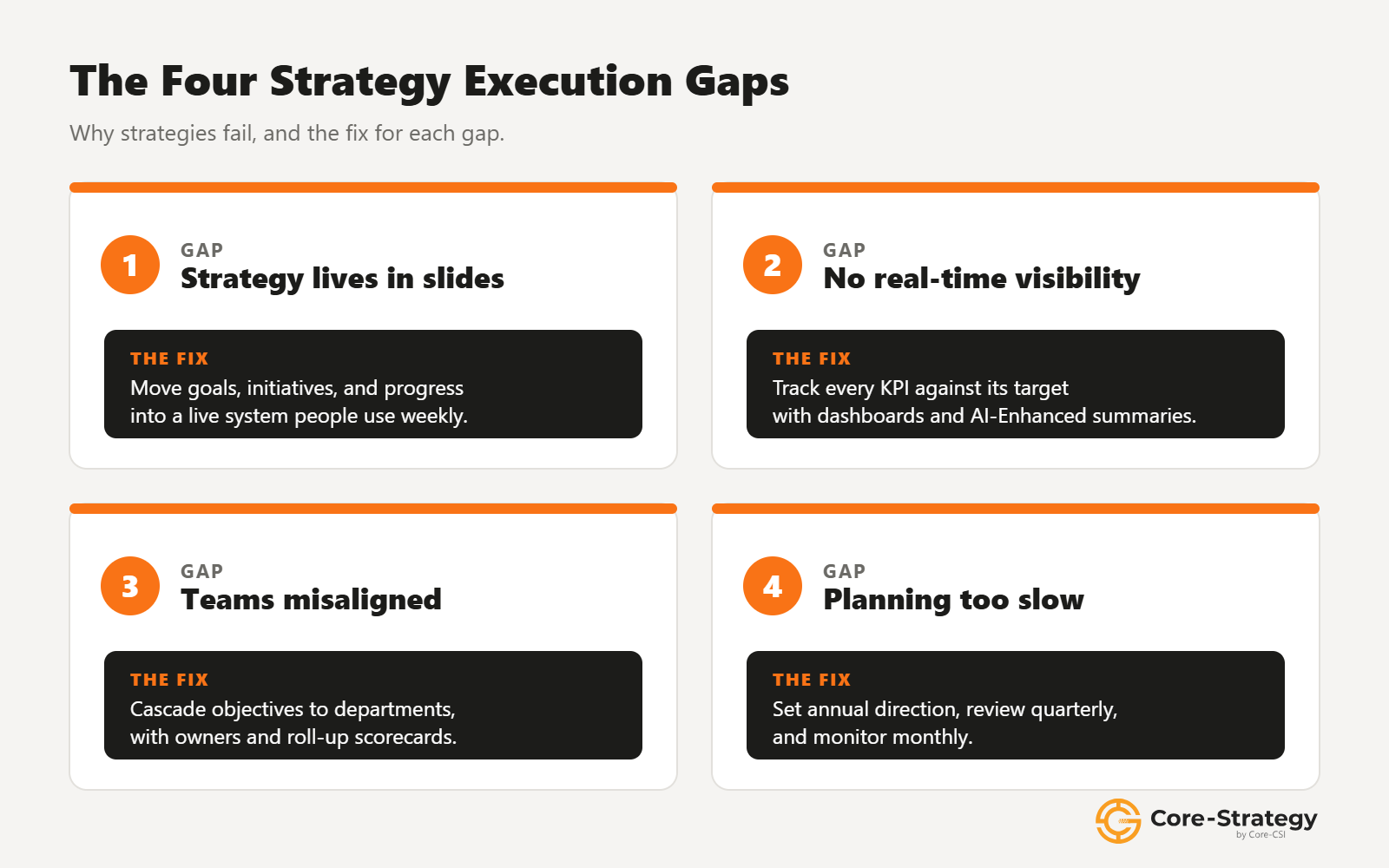
1. Strategy lives in slides, not systems
Most organizations plan in PowerPoint and execute in email. The strategy gets presented at an all-hands, leaders nod in agreement, and then everyone goes back to their day-to-day work. Three months later, nobody can tell you what the top three priorities are.
The Short Answer: Why Strategies Fail
Most strategies don’t fail because the strategy is wrong. They fail because the link between planning and doing breaks down. The four most common reasons are a strategy that lives in slides instead of a working system, leaders who can’t see performance in real time, teams that aren’t aligned on the same priorities, and planning cycles too slow to keep up with change.
The problem isn’t motivation — it’s infrastructure. When your strategy isn’t connected to a live system that people interact with daily, it becomes a document instead of a direction.
What to do: Move your strategy off slides and into a platform where goals, initiatives, and progress are visible in real time. Core-Strategy’s dashboard gives every team a live view of what the organization is working toward — no PowerPoint required. Objectives sit on an interactive strategy map, each linked to the KPIs that measure it and the projects that deliver it, so the strategy becomes something people work in every week.
2. Leaders lack real-time visibility into performance
By the time most executives see performance data, it’s already two weeks old. As a result, decisions get made on stale numbers and problems that could have been caught early become crises.
Real-time visibility isn’t just a technology problem — it’s a leadership problem. When leaders can’t see what’s happening across the organization as it happens, they default to gut feel or wait for the next report cycle.
What to do: Build a dashboard layer that aggregates KPIs, initiative progress, and team performance into a single view updated in real time. The goal isn’t more data — it’s the right data, visible at a glance, so leaders can act before problems escalate. Core-Strategy’s dashboards and AI reporting show the numbers that matter and highlight what changed, while AI-Enhanced summaries read like a short weekly update. Owners log actuals against targets each period, and trend lines show which measures are slipping before the next review meeting.
3. Teams are misaligned on strategic priorities
Misalignment is one of the most expensive hidden costs in any organization. When Finance optimizes for margin while Sales chases volume and Operations focuses on efficiency, the result is a company that works hard but moves slowly.
Most misalignment isn’t caused by bad intentions — it’s caused by disconnected planning. Each department builds their own goals without a clear line of sight to the organizational strategy above them. Consequently, the OKR framework, popularized by Google, was specifically designed to solve this by cascading objectives from the top of the organization down to every team.
What to do: Cascade your strategic objectives down through every department so each team’s goals are explicitly linked to the organization’s priorities. Core-Strategy makes this cascading process structured and visible. Enterprise and department scorecards run side by side, every objective and KPI has a named owner, and progress rolls up from each department to the organization. The AI-Enhanced Strategy Plan Assistant can also suggest goals, KPIs, and action steps aligned to your priorities.
4. Planning cycles are too slow for the pace of change
Annual planning made sense when markets moved slowly. Today, however, a competitor can launch a new product, a regulation can change, or a macroeconomic shift can upend your assumptions — all within a single quarter.
Organizations that plan once a year and review quarterly are always playing catch-up. By the time they’ve identified a problem and convened a planning session, the window to respond has closed. Many organizations still revisit their strategy only once a year, which leaves them permanently behind the curve.
What to do: Shift from annual planning to continuous strategy execution management. Set annual direction, review quarterly, and monitor monthly at minimum. Build in a structured process for updating priorities when conditions change — not as an exception, but as a standard part of how you operate. In Core-Strategy, targets can be adjusted by period without rewriting the objective, and the planning and execution loop keeps results feeding back into the plan.
What effective strategy execution looks like in practice
Organizations that consistently execute well share a few common habits:
They connect goals to work. Every initiative, project, and priority is explicitly linked to a strategic objective. Nothing exists in a vacuum.
They measure what matters. Rather than tracking dozens of metrics, they identify 5–7 KPIs that genuinely indicate whether the strategy is working — and they review them regularly. Learn more about how to choose the right KPIs for your organization.
They make progress visible. Leaders and teams can see at any moment how the organization is tracking against its goals. There are no surprises at the end of the quarter.
They adapt quickly. When something isn’t working, they don’t wait for the annual planning cycle to change course. They have a process for making strategic adjustments in real time.
They use technology as a backbone. Strategy execution platforms bring all of this together — connecting goals, tracking performance, surfacing risks, and keeping teams aligned in one place.
Getting started: a practical checklist
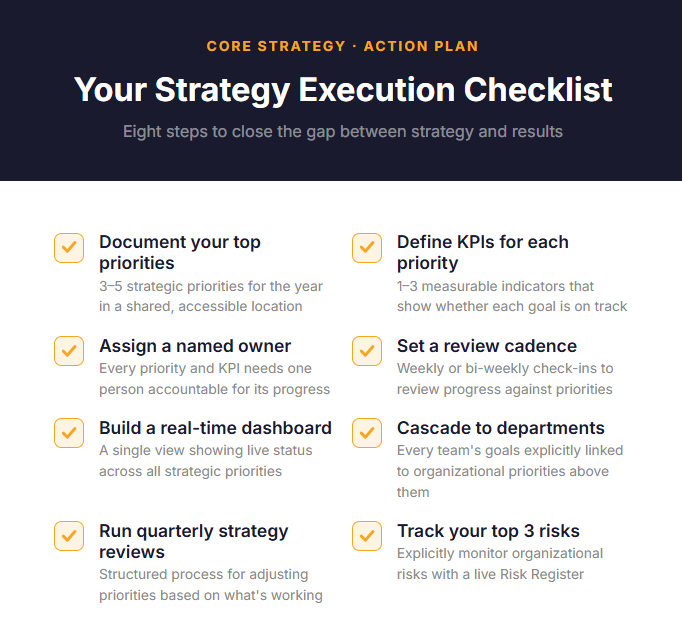
- Document your top 3–5 strategic priorities for the year in a shared, accessible location
- Define 1–3 measurable KPIs for each priority
- Assign a named owner to each priority and each KPI
- Set up a weekly or bi-weekly check-in cadence for reviewing progress
- Build a dashboard that shows real-time status across all priorities — see how Core-Strategy does this
- Cascade objectives to department level so every team knows how their work connects
- Establish a quarterly review process for adjusting priorities based on what’s working
- Identify your top 3 organizational risks and track them with a Risk Register
Frequently Asked Questions
Why do most strategies fail?
Most strategies fail during execution, not planning. The strategy stays in slides instead of a working system, leaders can’t see performance in real time, departments pursue conflicting priorities, and annual planning cycles can’t keep up with change.
Why do strategic initiatives fail during execution?
Initiatives usually fail when they aren’t clearly linked to a strategic objective, have no single owner, or aren’t measured against a target. Without those links, initiatives compete for resources and drift away from the strategy they were meant to deliver.
Why can’t leadership see which strategic goals are on track?
Usually because performance data lives in separate spreadsheets and reports that are assembled by hand. By the time the report reaches leadership, the numbers are weeks old. A live dashboard that tracks every KPI against its target fixes this.
Where does the execution bottleneck usually sit?
Most often, it sits in the handoff between leadership and the teams doing the work. Strategy gets set at the top, but objectives are never translated into department-level goals with owners and measures, so execution teams fill the gap with their own priorities.
The bottom line on strategy execution
Strategy execution isn’t a once-a-year event. It’s a continuous practice of setting direction, tracking progress, surfacing problems early, and adapting as conditions change.
Strategies fail far less often in organizations that do this well, and it’s not because they have better strategies than everyone else. Instead, they have better systems for bringing their strategies to life.
Core-Strategy is built for exactly this — giving leadership teams the platform to connect strategy to execution, track performance in real time, and keep every part of the organization moving in the same direction.
If your strategy is living in a slide deck, it’s time to move it somewhere it can actually be executed. See Core-Strategy in action.
Core-Strategy is a SaaS platform for strategy execution and leadership performance tracking. Learn more at core-strategy.us.